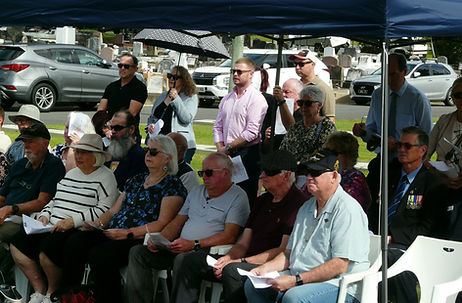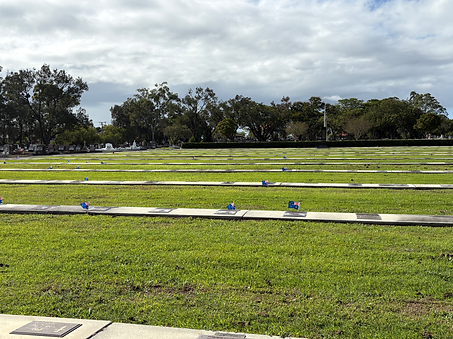
Lutwyche Cemetery unveiling ceremony May 16 2026
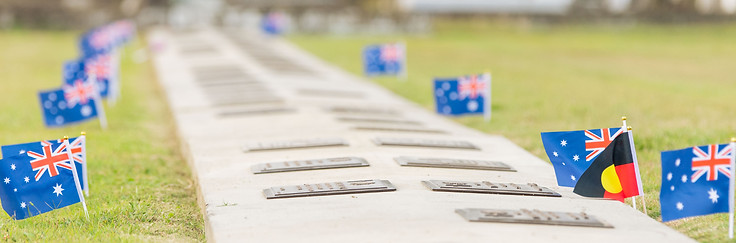
Anzac Portion 9
Of the 186 plaques unveiled on May 16 2026, 83 were manufactured and installed using funds from the Federal Government Marking (First World War) Private Graves Grants Program, secured by the Australian Remembrance Army in 2024. This funding also supported the installation of 13 plaques on the concrete beams in Anzac Portion 9. The other 103 plaques being unveiled today are of veterans who had applications submitted to the Repatriation Commission and were assessed as eligible for official commemoration. Their causes of death were determined to be attributable to their war service, and they have therefore been granted official war graves, which will be cared for in perpetuity by the Office of Australian War Graves. Through the dedicated efforts of the Australian Remembrance Army, these veterans were honoured with official war graves in recognition of their service.


Opening Speech — Mr Chris Mallcott, Vice President, Toowong RSL Sub Branch
Good Morning,
Today, we stand together on sacred ground here at Lutwyche Cemetery — not merely as individuals, but as a community united in remembrance, gratitude, and respect.
We gather for the unveiling of 186 plaques placed upon the graves of returned service personnel who served Australia in World War One, and whose resting places are now marked with the dignity and recognition they deserve.
For far too long, these veterans rested here in graves that gave no visible sign of their service. Silent. Unrecognised. Their stories at risk of fading with time.
Today, we help correct that.
Today, we say:
You are remembered.
You mattered.
Your service will not be forgotten.
These plaques are more than grave markers. They are symbols of identity restored, dignity returned, and service acknowledged. They remind us that a grateful nation still honours those who answered the call in a time of war, hardship, and sacrifice.
Among those remembered today are veterans who served at Gallipoli, on the Western Front, and in other theatres of the First World War. Some had also served in earlier conflicts. Some later served again. Many came home carrying wounds that could be seen, and many more carried wounds that could not.
Some returned to family, work, and quiet civilian life. Others slipped into history without the formal recognition they had earned.
But today changes that.
Behind every plaque is a story:
a person who left home,
a loved one who served beside mates,
a family member, a friend, a comrade,
a digger who carried memories for the rest of a lifetime.
They were ordinary Australians who did extraordinary things.
And what makes today especially meaningful is that this outcome did not happen by accident. It happened because people cared enough to act.
In particular, we acknowledge Cate Walker and Katrina Trevethan, founders of the Australian Remembrance Army and Friends of Lutwyche Cemetery Inc., who have worked with dedication and persistence to identify, mark, and restore honour to veterans resting here. Their work has already seen over 900 previously unmarked World War One veterans’ graves at Lutwyche Cemetery identified and marked.
Their work reminds us that remembrance is not passive. It is a responsibility.
When future generations walk through these grounds, they will no longer pass these graves without knowing. They will see names. They will see service. They will pause, read, and perhaps understand that freedom is never free.
That freedom has been paid for through service, sacrifice, hardship, and loss. It was carried by those who stepped forward when their country called, and by families who bore the cost of that service long after the uniforms were put away.
As Australians, we often speak of mateship, loyalty, and never leaving a mate behind.
Today, in a very real sense, we have honoured that promise.
Even after death.
Even after decades.
We have not left them behind.
To the families here today, this recognition belongs to you as well. Your loved ones served Australia, and Australia remembers them.
To the veterans present, thank you for carrying forward the torch of service.
And to those we honour today: may these plaques stand for generations as a permanent reminder that your nation remembers your sacrifice, your courage, and your duty.
Lest We Forget.
Commemorative speech: Katrina Trevethan & Cate Walker
Australian Remembrance Army founders
Friends of Lutwyche Cemetery Inc. founders & Management Committee members
Katrina:
Distinguished guests, serving and retired members of the Australian Defence Force, representatives of veteran organisations, families, friends, and members of our community — welcome.
My name is Katrina Trevethan. We thank you all for being here, and we extend a special welcome to the descendants of the veterans we are honouring today.
While the Australian Remembrance Army may be small, it is driven by a powerful purpose: Cate and I are united in our commitment to ensuring that no veteran is left without recognition at their final resting place.
Cate:
My name is Cate Walker.
We gather here today to honour and commemorate 186 World War One veterans whose graves here at Lutwyche Cemetery are now marked with plaques.
Each plaque represents a life of service — and a story that, until now, was unseen at their final resting place.
Among those honoured today are veterans who served at Gallipoli, those recognised for bravery, and many who continued to serve in later conflicts. Others returned home and lived long lives after the war, often carrying the physical and emotional effects of their service for decades.
Together, they reflect the full breadth of the Australian experience of war — sacrifice, survival, and return.
Katrina:
Of the plaques unveiled today, 83 have been installed through Federal Government grant funding, while 103 represent veterans now recognised as official war graves. Their deaths have been acknowledged as attributable to their war service, and their graves will be maintained in perpetuity by the Office of Australian War Graves.
This distinction is important because it highlights both the scale of the issue and the progress being made.
For many years, large numbers of returned service personnel had either not been identified or did not meet the criteria for official commemoration. As a result, their graves remained unmarked — not because their service lacked significance, but because of the criteria of the Office of Australian War Graves and the personal circumstances of those who returned.
Through persistence, research, and advocacy, we are changing that.
Cate:
Behind every name is a personal story.
Many of the veterans resting in these graves were immigrants, with no immediate family in Australia. Others had become separated from family and community through the hardship of returning to civilian life after World War One.
The wounds they carried were not always visible, and what we would now recognise as post-traumatic stress was not properly understood in their time. When they died, some were buried in public or pauper graves. Others were quietly laid to rest by families who, for financial, personal, or social reasons, could not provide a headstone or service plaque.
Across the generations, their burial places — and too often their service — faded from public memory.
Katrina:
The 186 veterans we honour today were born across Australia and around the world — from Queensland to Scotland, Ireland to New Zealand, and beyond.
They came from different backgrounds, served in different ways, and lived very different lives — yet they are united here by their service to Australia.
This diversity is a powerful reminder that the story of our nation has always been shaped by many voices, many journeys, and many sacrifices.
Cate:
Places like this are not only about the past; they help guide the future. They teach new generations about the true cost of war: the lives changed, the families affected, and the burdens carried long after conflict ends.
Each marked grave stands as a quiet reminder of sacrifice, and of the importance of striving for peace, understanding, and compassion in our own time.
After decades without recognition, these graves now bear plaques commemorating their service to Australia, ensuring their names endure among those remembered for their duty and sacrifice.
Each plaque represents a commitment:
that these individuals will not be forgotten again,
that their service will be visible,
and that their contribution to our nation will be acknowledged where they now rest.
By marking these sites, we are restoring more than recognition — we are restoring identity, dignity, and connection.
Katrina:
This work does not end here.
Across the country, there remain many thousands of veterans resting in unmarked graves. Here at Lutwyche Cemetery alone, Cate and I have identified approximately 250 World War Two veterans whose graves remain unmarked.
Sadly, current grant funding for the marking of unmarked graves is limited to World War One service personnel, meaning that many thousands of veterans who served in conflicts before or after World War One still remain without recognition at their final resting place.
Through ongoing research, we continue to identify these individuals, restore their stories, and ensure they are properly recognised.
Cate:
We are pleased to announce that earlier this year, we secured further grant funding from the Federal Government’s Marking Private Graves Program to mark 120 unmarked World War One graves in Toowong Cemetery.
This will form the basis of our next unveiling ceremony, and we warmly invite you to join us at Toowong Cemetery in the future for our next chapter of remembrance.
To all who have supported this work, and especially the descendants of the veterans we honour today, we extend our sincere gratitude.
Katrina:
We would now like to invite our Master of Ceremonies, retired Major Chris Moon, to please come forward.
Over the past five years, we have had the privilege of working closely with you to ensure every detail on each plaque has been accurate and respectful to the veterans we honour today.
Cate and I would like to present you with this small token of our appreciation for the generous assistance you have given us over the past five years. Your dedication has played a significant part in this volunteer work, and we are deeply grateful for all that you have done to assist us along the way.
Cate:
We sincerely thank Mr Chris Mallcott and the Toowong RSL Sub Branch, who have gone above and beyond to assist us.
We also thank
-
Lachlan Carkeet, Musical Director Graham Drane, and the members of the Pine Rivers Brass Band for your presence here today
-
Bugler Mr John George
-
Brisbane City Council Cemetery Management for their continuing assistance with our voluntary work
-
Peter Thurgood and the staff at Queensland Births, Deaths and Marriages for their assistance with death certificates
-
Jade and the team at Worssell and Co for the manufacture of the plaques
-
Eve and the staff at the National Archives of Australia in Brisbane
-
Dan and the team at Queensland Heritage Masonry for their expert installation of the plaques.
Katrina:
We extend our heartfelt thanks to our fellow members of Friends of Lutwyche Cemetery. Since our formation in 2021, you have volunteered alongside us to care for this important historic site. Cate and I sincerely appreciate your friendship, dedication, and generosity.
Finally, we offer our gratitude to our husbands and families, whose unwavering encouragement has enabled us to undertake this ongoing project.
Together, you have all helped make this work — and today — possible.
Cate:
And to those we honour today: we acknowledge your service, your sacrifice, and your place in our nation’s history.
Your identity and dignity have now been restored. You are remembered.
Katrina and Cate:
Lest We Forget
Gallery